

IQF Vegetable Supplier Compliance Guide: GFSI, HARPC, and FSVP Documentation for Food Manufacturers

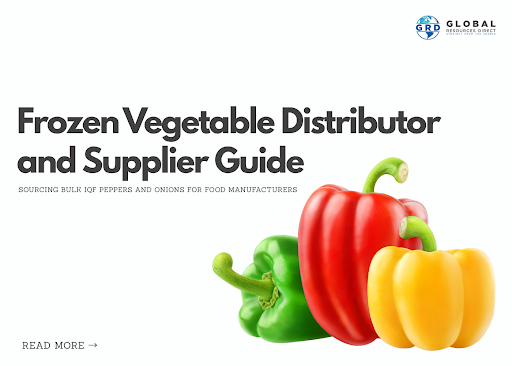
Before you approve an Individual Quick Frozen (IQF) pepper supplier, ask for three things. You need a current Global Food Safety Initiative (GFSI) benchmarked certificate and documents that support your Hazard Analysis and Risk-Based Preventive Controls (HARPC) supply-chain program. For imported lots, you also need Foreign Supplier Verification Program (FSVP) records.
GFSI certification is a buyer requirement, while HARPC and FSVP are federal rules. Below is what each covers and how to qualify an IQF vegetable distributor.
Why Compliance Matters When Sourcing IQF Vegetables
IQF vegetables are washed, cut, and frozen, but freezing does not eliminate every hazard. Listeria monocytogenes can survive frozen storage, so it sits near the top of hazard analyses for frozen produce.
When a supplier misses a hazard, the problem moves into every product made with that ingredient. Clear supplier documentation helps your team catch gaps before a lot reaches the line and shows auditors how each hazard is controlled.
A hazard analysis for IQF peppers typically covers three hazard groups:
-
Biological hazards, such as Listeria monocytogenes and Salmonella
-
Chemical hazards, such as pesticide residues and undeclared allergens from shared lines
-
Physical hazards, such as stems, metal, glass, or plastic fragments
GFSI Certification for IQF Vegetable Suppliers
Many US retailers and food manufacturers require a GFSI-benchmarked certificate before approving a supplier. A GFSI-certified IQF supplier has passed a third-party food safety audit under a recognized scheme.
What GFSI Recognition Means
GFSI does not audit or certify companies itself. The organization benchmarks certification programs and recognizes those that meet its requirements.
Schemes Common on IQF Vegetable Certificates
Safe Quality Food (SQF), Brand Reputation through Compliance Global Standards (BRCGS), and Food Safety System Certification (FSSC) 22000 are widely used by frozen vegetable processors. Treat them as equivalent unless a customer names one; see this breakdown of food safety certifications for bulk suppliers for scheme details.
What to Check on the Certificate
Confirm the site address matches the plant that packs your peppers, not the trading company. Check that the scope lists frozen vegetables and the expiry date covers your contract. Ask for the latest audit grade as well.
HARPC Documentation Your IQF Vegetable Supplier Should Support
HARPC comes from the Food Safety Modernization Act (FSMA) and is enforced by the Food and Drug Administration (FDA) under Title 21 of the Code of Federal Regulations (CFR), Part 117. Your facility needs a written food safety plan, and some of its controls depend on your supplier.
Your Supply-Chain Program Obligations
When a hazard is controlled before the product reaches you, you need a supply-chain program built on approved, verified suppliers. For hazards that could cause serious illness or death, the rule calls for an onsite audit before first use and at least annually thereafter.
Documents to Request From Your Supplier
Request these during supplier approval:
-
GFSI certificate and latest audit summary
-
Spec sheet for the exact cut and color
-
Certificate of Analysis (COA) for each lot shipped
-
Hazard analysis summary or food safety plan letter
-
Listeria environmental monitoring summary
-
Allergen statement and recall procedure
-
Organic, kosher, or halal certificates if your label claims them
FSVP Requirements for Imported IQF Vegetables
If your IQF peppers are packed outside the US, FSVP applies. A US party must verify that the foreign plant meets US food safety standards.
Who Holds FSVP Responsibility
Under the rule, the FSVP importer is the US owner or consignee of the food at the time of entry. An IQF vegetable distributor that imports and resells the product usually holds it. Ask in writing who is named as the FSVP importer.
What an FSVP File Contains
A complete FSVP file for IQF peppers typically includes:
-
A hazard analysis for each food
-
A review of the supplier's compliance history
-
Verification, such as on-site audits, testing, or records review
-
Corrective actions when a supplier falls short
-
A reevaluation at least every three years
-
Records kept for at least two years
GFSI vs HARPC vs FSVP Compared
The three requirements overlap, but each one has a different owner.
| Attribute | Tapioca Flour | Cassava Flour |
|---|---|---|
| Source | Starch extracted from cassava root | Whole peeled cassava root |
| Fiber | Minimal, removed during extraction | Retained from the root |
| Water absorption | Low | High |
| Texture in finished product | Chewy, stretchy, and glossy | Soft, with more crumb and body |
| Main roles | Thickener, binder, chew, and crisp edges | Primary flour, structure, and bulk |
| Gluten status | Naturally gluten-free | Naturally gluten-free |
| Label name | Tapioca flour or tapioca starch | Cassava flour |
How to Qualify an IQF Pepper Supplier
Use this checklist for every new pepper item or blend:
-
Confirm the GFSI certificate covers the packing site and frozen vegetables.
-
Request the spec sheet for each item, such as IQF Diced Green Jalapeno Peppers or an IQF Fajita Pepper Onion Blend, from the spec sheet library.
-
Ask who the FSVP importer is and request a file summary.
-
Map each document to a hazard in your HARPC plan.
-
Check the first three lot COAs against the spec.
-
Track certificate expiry and three-year reevaluations.
Choosing a Compliant IQF Pepper Supplier
The right IQF pepper supplier makes compliance easier for your Quality Assurance (QA) team. Look for IQF vegetables manufacturers and distributors that share certificates quickly and name the FSVP importer clearly.
Need bulk IQF Bell Peppers or other IQF Fruits and Vegetables with complete QA documentation? Contact Global Resources Direct for same-day quotes, competitive pricing, and flexible minimums.
Frequently Asked Questions
What certifications should a bulk IQF vegetable supplier have?
A bulk IQF vegetable supplier should hold a current certificate under a GFSI-recognized scheme such as SQF, BRCGS, or FSSC 22000. Organic, kosher, or halal certificates matter when your label or customer requires them.
Is GFSI certification required by law?
No, GFSI certification is voluntary under US law. Many retailers and food manufacturers still require it as a condition of supplier approval.
How is HARPC different from HACCP?
Hazard Analysis and Critical Control Points (HACCP) centers on critical control points in a process. HARPC adds preventive controls for sanitation, allergens, and the supply chain, plus a recall plan.
Who is responsible for FSVP on imported IQF peppers?
The FSVP importer is the US owner or consignee of the food at the time of entry. Confirm in writing whether that is your supplier or your company.
How often should you reverify an IQF pepper supplier?
Check the GFSI certificate at each renewal, typically yearly. FSVP and HARPC rules require reevaluation or plan reanalysis at least every three years.
Does a distributor's certificate cover the packing plant?
Not always, because a distributor may hold a certificate covering only storage or trading. Ask for the certificate of the facility that packs your IQF vegetables.