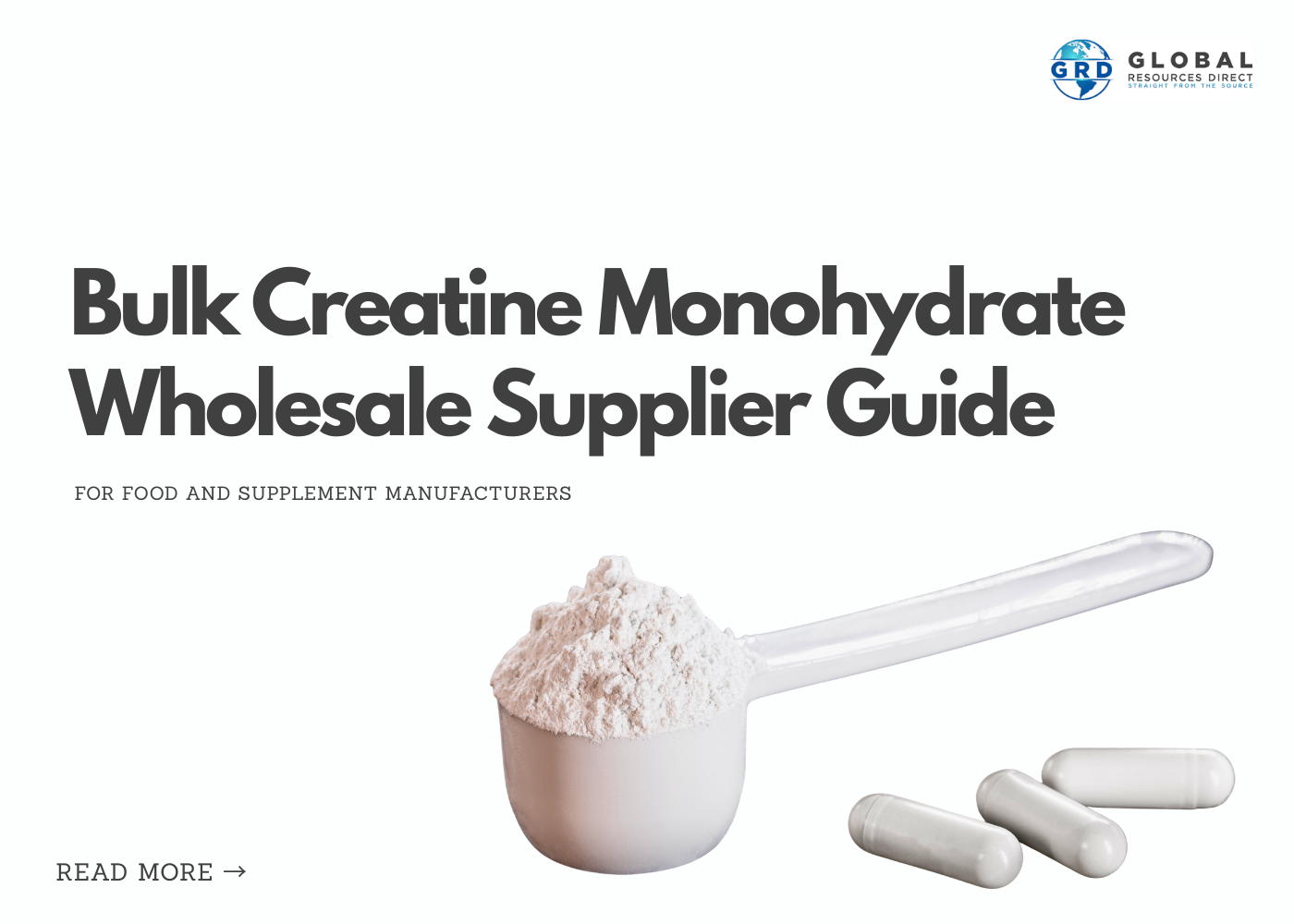


Bulk Creatine Monohydrate Wholesale Supplier Guide for Food and Supplement Manufacturers

The right bulk creatine monohydrate supplier gives you a documented spec, not just a price. Look for purity of 99.5% or higher by high-performance liquid chromatography (HPLC), a mesh size matched to your format, impurity and heavy metals results on every certificate of analysis (COA), and US inventory that ships on your schedule.
Below, you will see which specs matter, where supplement and food manufacturers buy creatine wholesale, and a three-step process to qualify any supplier before your first production run.
What Bulk Creatine Monohydrate Is Used For
Creatine monohydrate is a white, odorless powder that manufacturers buy as an ingredient rather than a finished product. Two buyer groups drive most wholesale demand, and each works under different Food and Drug Administration (FDA) rules.
Supplement Brands and Contract Manufacturers
Supplement brands and contract manufacturing organizations (CMOs) use bulk creatine monohydrate powder in standalone powders, capsules, tablets, and multi-ingredient blends. Under 21 CFR Part 111, you must set identity, purity, strength, composition, and contaminant specs for each component. You may rely on a supplier's COA only after you confirm its results are reliable.
Food and Beverage Manufacturers
For food manufacturers, the FDA had no questions about one producer's conclusion that creatine monohydrate is generally recognized as safe (GRAS) in energy drinks, protein bars, shakes, meal replacements, meat analogues, and dry mixes. The notified level is 1 g creatine (1.12 g creatine monohydrate) per serving, so check your use level against that notice.
Bulk Creatine Monohydrate Powder Specs to Check Before You Buy
A low quote means little if the spec sheet cannot back it up. Ask every supplier to confirm the following parameters in writing before you compare pricing.
Purity and Assay Method
Ask for purity of 99.5% or higher, tested by HPLC on every lot. HPLC measures creatine directly and can also flag related impurities in the same run. Request a lot-specific COA, not a generic product data sheet.
Mesh Size and Particle Grade
Micronized 200-mesh powder is the usual choice for drink mixes and dry blends, since finer particles disperse evenly and segregate less during mixing. Standard 60-mesh grade often suits capsules, tablets, and formats where particle size does not change the finished product. Settle the mesh first so every supplier quotes the same grade.
Process Impurities and Heavy Metals
Creatinine, dicyandiamide (DCD), and dihydrotriazine (DHT) are the main process impurities in creatine. The specification in GRAS Notice 931 caps them at 100, 50, and 3 milligrams per kilogram (mg/kg), and holds lead, arsenic, cadmium, and mercury to 0.1 mg/kg each. Ask for all seven results on every lot.
Use this checklist to compare spec sheets side by side.
|
Parameter |
What to Request |
Why It Matters |
|
Purity |
99.5% or higher by HPLC, per lot |
Confirms active content and label accuracy |
|
Mesh size |
200-mesh micronized or 60-mesh standard |
Controls dispersion, flow, and blend uniformity |
|
Process impurities |
Creatinine, DCD, and DHT results |
Shows how well synthesis and drying are controlled |
|
Heavy metals |
Lead, arsenic, mercury, and cadmium per lot |
Supports contaminant specs and retailer QA files |
|
Moisture |
Low moisture spec on the COA |
Reduces caking in storage and on the line |
|
Documentation |
COA, spec sheet, allergen statement, kosher certificate |
Drops straight into your supplier qualification file |
Where to Buy Bulk Creatine Monohydrate for Supplement Manufacturing
Most buyers source creatine wholesale through one of three routes. The same options apply to supplement brands and to creatine monohydrate wholesale for food manufacturers, though the paperwork each needs differs.
Direct From Overseas Producers
Buying direct can lower unit cost at very high volumes. You take on import, customs, and supplier qualification yourself, and minimum orders are often sized in full containers. Longer lead times also make safety stock harder to manage.
Online B2B Marketplaces
Business-to-business (B2B) marketplaces make suppliers easy to find but harder to verify. Listings often show a generic spec, and you may not learn which factory made a lot until it lands.
US Ingredient Distributors
A domestic bulk creatine monohydrate supplier holds US inventory, ships less-than-truckload (LTL) or full truckload, and sends a COA with every lot. For most small and mid-size brands, this route balances unit cost, speed, and documentation. Ask whether the distributor buys direct from manufacturers or through another reseller, since each extra step thins traceability.
How to Qualify a Bulk Creatine Monohydrate Supplier
A short, repeatable process holds every new supplier to the same standard. The general framework for choosing the right food ingredients supplier applies here, with three creatine-specific checks.
Step 1. Request the Spec Sheet and a Lot COA
Ask for the current spec sheet plus a COA from a recent production lot. Compare both against your internal component spec line by line. Flag any missing impurity or heavy metal results before you go further.
Step 2. Test a Sample at a Third-Party Lab
Send a sample to an ISO/IEC 17025-accredited lab to confirm purity, impurities, and heavy metals. Matching results let you begin relying on the supplier's COA, as Part 111 allows. Re-test periodically to keep that reliance current.
Step 3. Confirm Packaging, Storage, and Buying Terms
Standard bulk packaging is 25 kg (about 55 lb) fiber drums with moisture-barrier liners, with super sacks and totes for high-volume lines. Store sealed in a cool, dry place away from light, and rotate lots first in, first out (FIFO). Then weigh contract versus spot purchasing against how steady your volume is.
Choosing the Right Bulk Creatine Monohydrate Supplier
Price matters, but documentation and lot consistency decide whether creatine runs cleanly. Pick a supplier whose spec, COA, and inventory fit both your format and your compliance file.
Need bulk creatine monohydrate or other proteins and powders for supplement or food production? Contact Global Resources Direct for same-day quotes, competitive pricing, and flexible minimums.
Frequently Asked Questions
What is the difference between micronized and standard creatine monohydrate?
Micronized creatine is milled to a finer 200-mesh particle size for better dispersion in drink mixes and dry blends. Standard 60-mesh grade is coarser and often works well in capsules and tablets.
What purity should bulk creatine monohydrate powder have?
Most manufacturers specify 99.5% or higher, tested by HPLC on each lot. Ask for creatinine, DCD, and DHT results alongside the purity figure.
Can creatine monohydrate be used in foods like protein bars?
FDA had no questions about a GRAS notice covering creatine monohydrate in foods such as protein bars, shakes, energy drinks, and meat analogues at 1 g creatine per serving. Confirm your product and use level with your regulatory team before launch.
Where can I buy bulk creatine monohydrate for supplement manufacturing?
Common sources are overseas producers, online B2B marketplaces, and US ingredient distributors that hold domestic stock. Distributors usually offer the fastest delivery and the simplest documentation for small and mid-size brands.
What packaging does bulk creatine monohydrate ship in?
Standard packaging is 25 kg fiber drums with moisture-barrier liners. Super sacks and bulk totes are common for high-volume production.
How long does bulk creatine monohydrate last in storage?
Sealed creatine monohydrate typically carries a 24 to 36-month shelf life when kept cool, dry, and away from light. Always confirm the date on the lot-specific spec sheet.